*MS
Water in the City
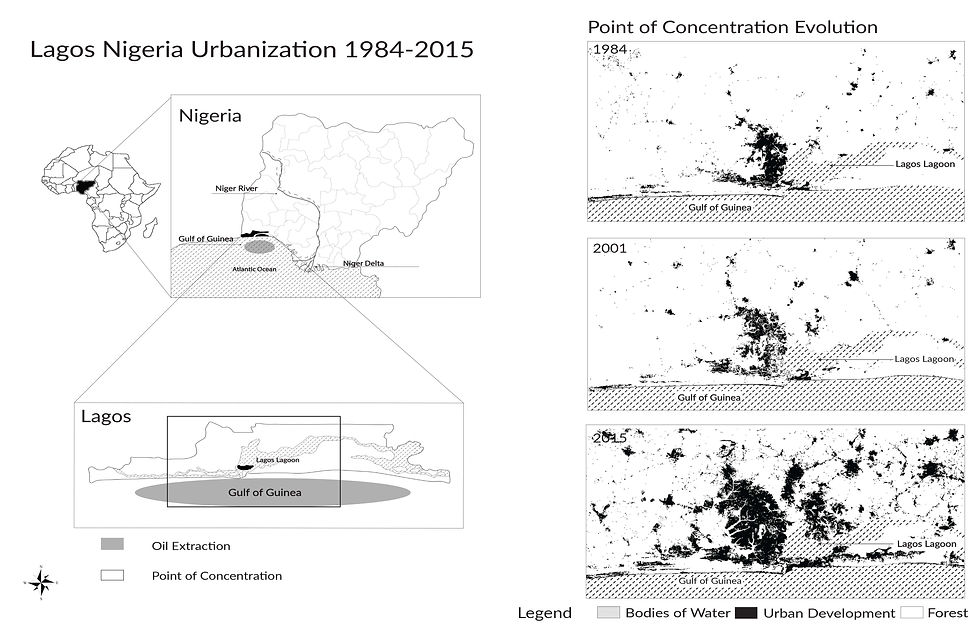
I chose Lagos, Nigeria, as my focal city, and the accompanying graphic on the left was crafted to augment the insights presented in the paper.
Overview
I enrolled in the "Water in the City" course at Cornell, where the curriculum delved into how water influences urban environments. As part of the course requirements, we conducted an in-depth analysis for our final paper, selecting a specific city to examine how bodies of water in the vicinity influence aspects such as community dynamics, economic structures, and overall quality of life.
Tool Kit
Google Earth, Adobe Photoshop, Adobe illustrator
Description
Nigeria ranks among the top ten global crude oil producers. The graphic illustrates the process of crude oil extraction from the Gulf of Guinea, highlighting a comparative analysis with urban development and deforestation in Lagos. The depiction underscores the consequential impact of pollution resulting from both oil extraction activities and deforestation, contributing to a noticeable shift in the shoreline.
Research Notes
Nigeria's Origins in
Exploitative Business
-
Nigeria's historical roots are traced back to the era of the Slave Coast, evolving from a slave trade hub to a palm oil-centric business under British influence.
-
George Dashwood Taubman Goldie established the United African Company in 1879, later transformed into the Royal Niger Company, solidifying British control over the palm oil trade.
-
Goldie manipulated local chiefs, imposing unfair trade deals in English law and giving the British exclusive rights to export palm oil.
Imperialist Actions
and Consequences
-
The Berlin Conference of 1884-1885, where European powers divided Africa, excluded Africans, shaping Nigeria's fate without their input.
-
King JoJo of Opobo's attempt to export palm oil independently led to his exile and poisoning, demonstrating the harsh consequences of opposing British interests.
-
King Koko's resistance against the Royal Niger Company in 1895 resulted in the destruction of Brass City by the British Royal Navy, showcasing the brutal retaliation against those challenging British control.
Corporate Transition
to National Identity
-
Goldie sold the Royal Niger Company's territory to the British government in the late 1800s, marking the transformation of a corporate entity into the territory known as Nigeria.
-
Lord Lugard combined the Southern and Northern Protectorates in 1914, formalizing the amalgamation of diverse regions into a single entity.
-
Nigeria gained independence in 1960, marking a transition from a corporate structure to a sovereign nation, although the impact of corporate exploitation lingered.
Continuity of Economic
Exploitation
-
The Royal Niger Company's transition to Niger Company Ltd, later acquired by Unilever, highlights the continuity of economic exploitation by multinational corporations in Nigeria.
-
The shift from palm oil to crude oil as a major resource indicates the adaptability of the exploitative infrastructure, with potential future shifts towards lithium business.
-
The lingering question emerges: Can a business-oriented foundation be transformed into a sustainable and equitable nation?
Legacy of Colonial Capitalism
-
Initially designed for resource extraction, Nigeria's infrastructure continues to shape the nation's economic landscape.
-
The trajectory from palm oil to crude oil and potential future ventures like lithium underscores the enduring legacy of a capitalist colonial design for profit.
-
Nigeria grapples with the challenge of reshaping its economic foundations to prioritize the well-being of its people over exploitative business interests.
© 2024 by Martha Sam.
